Book a consultation

30 minute meeting

Thank you

We’ll reach out within one business day. If you don’t hear from us, check spam and promotions folders.

Contact us

Fill out the form to send us a message

Attach related materials (.pdf, .docx, .odt, .rtf, .txt, .pptx; max 5 MB)
Or

Hold On

Binary Studio is a boutique software development company with a 4.9/5 rating on Clutch. For 20 years of work, we have helped over 200 companies build successful products.

Let's discuss how we can help you!

Building an autonomous AI agent to cut property managers’ manual workload by 10× star star star star star

Building an autonomous AI agent to cut property managers’ manual star star star star star workload by 10×

  • LOCATION: flag USA

  • Type of Service: Custom Software Development

  • INDUSTRY: Real Estate

  • KEY TECHNOLOGY: Vercel AI SDK

  • Project Type: AI Agent

  • DURATION: October 2025 – Present

  • 3

    min avg
    response time

  • 0.1

    ¢ cost
    per email

  • 80

    % emails
    fully automated

The Client

One of our client's strategic partners, a property operator managing several residential complexes, needed a better way to handle tenant communication. At each complex, property managers received around 100 emails per day from tenants and prospective renters. Managing this volume manually slowed response times, reduced consistency, and left some messages unanswered for days.

The operator wanted to automate this communication, but the AI features offered by existing property management platforms did not match its workflows and processes. Our client saw an opportunity to meet this need with a purpose-built solution and develop it into an AI product for the broader property management industry.

Having successfully worked with Binary Studio on a previous project, the client invited our team to build the platform.

Objectives

The client initially envisioned an AI assistant that would draft email replies for property managers, with one property operator ready to pilot the solution. As we learned more about the operator’s workflows, the scope expanded from assisting managers with replies to automating communication safely and building a product that could serve multiple operators. This led to three core objectives:

  • 01

    Reduce the volume of emails managers handle manually.

    The system had to filter incoming emails, answer routine questions, and send only cases requiring human judgment to managers.

  • 02

    Reply automatically and safely.

    Every response had to use verified information from property documents and live systems. If the agent lacked information or confidence, it had to escalate the email to a manager.

  • 03

    Make the product scalable across properties.

    New operators and residential complexes had to be added through configuration rather than custom development, enabling the solution to grow into a standalone product.

AI Agent Development Services

Automate repetitive manual work, reduce operational costs, and let your team focus on tasks that require human judgment.

Learn more

Solution and Outcome

  • The client’s initial Python prototype had already validated the core idea. Binary Studio turned that concept into a production-ready, multi-tenant platform, rebuilding the AI agent and integrating it into the operator’s daily workflow. Our team also developed the web application, infrastructure, CI/CD pipelines, and external integrations required to operate and scale the product.
  • The following four stages show how the solution evolved from assisted email drafting to controlled autonomous communication.
AI Real Estate Agent Development for Property Operations-2
Node.js
AI Real Estate Agent Development for Property Operations-3
React
AI Real Estate Agent Development for Property Operations-4
PostgreSQL
AI Real Estate Agent Development for Property Operations-5
OpenRouter
AI Real Estate Agent Development for Property Operations-6
Vercel
  • Stage 1

    Building the platform and initial agent

    Off-the-shelf tools such as n8n, Zapier, and Make did not provide enough control over email processing or the multi-tenant architecture the product required. The team therefore built a custom platform. Node.js handled authentication, integrations, and the PostgreSQL knowledge base, while a separate Python service parsed uploaded documents and generated email drafts. The first version was soon running against the operator’s live inbox in shadow mode, generating replies for managers to review without sending them automatically.

    Building a custom platform also gave the team control over how its AI infrastructure was designed. Two early architectural decisions were particularly important. First, the team chose cloud-based AI APIs over self-hosted models because they were more cost-effective at this scale. The selected providers offered enterprise data controls under which submitted data was not used for model training, helping protect tenant correspondence. Second, the team routed all AI requests through OpenRouter, making it possible to switch models through configuration rather than rewrite the integration.

  • Stage 2

    Rebuilding the agent with Agentic RAG

    As usage increased, the Python prototype became unreliable under load and difficult to extend. Instead of continuing to patch it, the team rebuilt the agent from the ground up within the main Node.js platform using the Vercel AI SDK. The rewrite took one focused week and also introduced a more efficient retrieval approach.


    Python prototype

    Rebuilt agent

    LLM interaction

    Parsed model responses using custom regular expressions

    Used native tool calling and structured outputs

    Information retrieval

    Loaded documents into the context for every email

    Searched the knowledge base only when necessary

    Missing information

    Generated a response using whatever information was available

    Identified missing information and escalated the case

    Processing cost

    Added the same retrieval overhead to every email

    Adjusted processing to the complexity of each case

    Observability

    Provided limited visibility into the agent’s behavior

    Recorded full execution traces in the admin panel

  • Stage 3

    Expanding into a standalone email client

    As the operator used the product, the limitations of integrating the assistant with Gmail became increasingly clear. Managers needed workflows and features that Gmail’s interface could not support. The team therefore expanded the product from an AI assistant connected to Gmail into a standalone email client.

    This required the largest refactoring of the engagement. The team recreated the essential email functionality within the platform and added smart filtering, task management, and a complete log of the agent’s actions. Once the new client was ready, all property managers moved their daily email workflows from Gmail to the platform.

  • Stage 4

    Rolling out autonomous email replies

    Managers were sending 75% of the AI-generated drafts without making changes, indicating that the agent was ready for greater autonomy. The operator therefore asked the team to enable automatic replies. To do this safely, the team introduced a governance pipeline in which the agent could act only through verified, purpose-built tools.

    case-table.avif

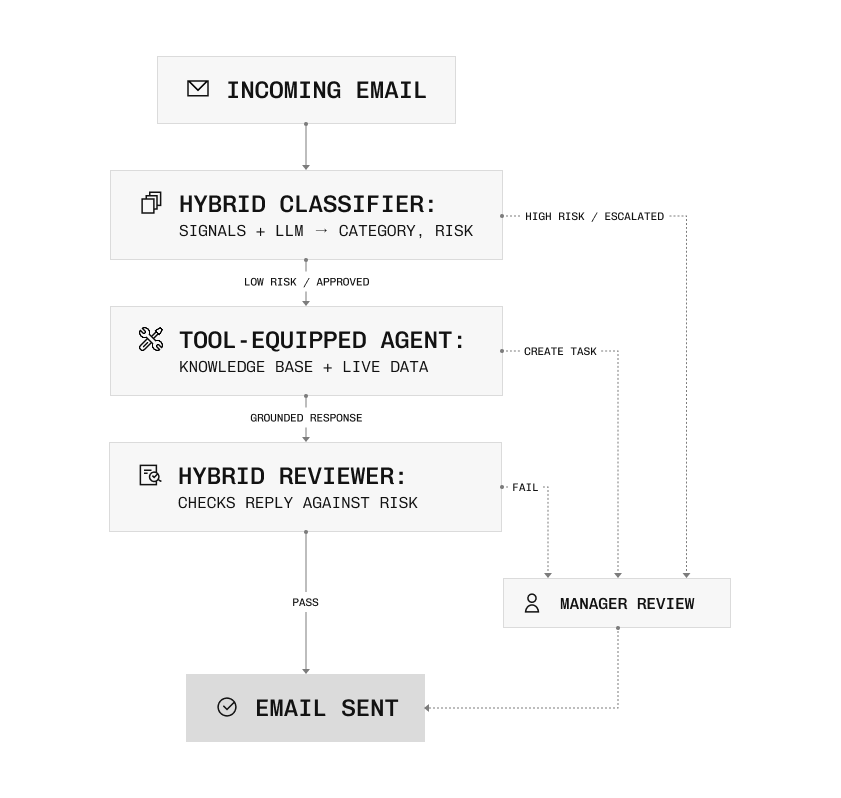
    AI agent governance architecture

    Each incoming email first passed through a hybrid classifier, which combined rule-based checks with LLM analysis to determine its category and risk level. Approved emails were passed to the tool-equipped agent, which either generated a grounded response or created a task for a manager when human input was required. Before a response was sent, a hybrid reviewer checked it against the original risk assessment.

    Automatic sending was introduced gradually, beginning with the lowest-risk email categories. Manager corrections and agent escalations were then used to improve the system’s performance. As a result, managers could focus on a small number of priority emails instead of reviewing the entire inbox.

Impact on Daily Operations

Aspect

Before

After

Manager workload

~100 emails a day on average, with seasonal peaks

Only 1–10 priority emails require manager attention

Response time

9.4 hours on average; 21.8 hours at the 90th percentile; some emails remained unanswered for days

~3 minutes on emails handled by the platform

Email automation

Every email was processed manually

~80% of incoming emails are automatically filtered or answered;  

~40% of emails requiring a response are answered autonomously


Processing cost

No automated processing

Simple emails cost a fraction of a cent; processing cost scales with complexity

Turning an In-House Solution into a Market-Ready Product

  • The platform has changed how the operator manages email. It filters routine messages, answers what it can verify, and creates tasks when human input is needed, letting managers focus on priority cases. Tenants and prospective renters get responses within minutes, grounded in the property's policies and live data, with classification and review safeguards keeping automatic replies controlled.
  • The product was designed to expand beyond the initial operator. Its multi-tenant architecture allows new operators and properties to be onboarded through configuration rather than custom development. The platform is also independent of any single AI model, while its retrieval process adjusts processing and cost to the complexity of each email. Together, these choices create a repeatable model for serving new customers using the same core system.
  • This gives the client a scalable foundation for pursuing a substantial and growing commercial opportunity. The property management software market is projected to grow from $6.53 billion in 2026 to $9.93 billion by 2031, led by the residential segment. With the platform already live across two large properties, further onboardings planned, and Outlook support in development, the client is well positioned to bring the product to more operators across the industry.

About Binary Studio

  • Binary Studio is a boutique software development company, regularly praised for its unique blend of engineering excellence and product ownership that enables its clients to build robust and scalable software products.
  • With our development team made up of top 0.5% international tech talent, we build web and mobile platforms using Node.js, .NET, React Native, Flutter, and integrating AI and ML. We also offer full-cycle QA and project management services to ensure the efficient delivery.
  • Our clients see us as a trusted partner dedicated to turning visions into great products. This is proven by 200+ delivered projects, more than two decades of business excellence, and stellar customer reviews.

Schedule a tech consultation

Client ManagerClient Manager

Christina Berko ⠀ 

Client Manager

Maria Kudriavtseva ⠀ 

Pre-Sales Project Manager

Thank you

We’ll reach out within one business day. If you don’t hear from us, check spam and promotions folders.

Send us a message

Attach related materials (.pdf, .docx, .odt, .rtf, .txt, .pptx; max 5 MB)