Book a consultation

30 minute meeting

Thank you

We’ll reach out within one business day. If you don’t hear from us, check spam and promotions folders.

Contact us

Fill out the form to send us a message

Attach related materials (.pdf, .docx, .odt, .rtf, .txt, .pptx; max 5 MB)
Or
ellipse angle arrow card

Building a CBT-Based AI Mental Health App from star star star star star Concept to User Adoption

Building a CBT-Based AI Mental Health star star star star star App from Concept to User Adoption

  • 1

    Product
    Owner

  • 1

    Backend
    Developer

  • 1

    Mobile
    Developer

  • 1

    Part-Time
    Designer

  • 1

    QA
    Engineer

The Client

Binary Studio's experience building healthcare platforms like Everbeat and Releaf, combined with our earlier mental health companion prototype CalmPal, positioned us to recognize a significant market opportunity. Client inquiries for AI mental health projects were increasing in ways that indicated genuine customer demand—a pattern reflecting a widespread problem cutting across demographics. The repeated nature of these inquiries, combined with our background in healthcare technology, led us to explore building our own solution.

The gap in the market was clear: while traditional therapy remained financially or geographically out of reach for many, and digital alternatives had expanded significantly, there was still a missing piece in solutions that combined evidence-based therapeutic techniques with sustainable daily practice. Existing apps either focused on guided meditation and mood tracking, or offered therapy-adjacent services, but few provided the structured cognitive work that drives behavioral change in an accessible format.

The numbers validated what we were seeing firsthand—the AI mental health sector is projected to grow from $1.6 billion in 2025 to nearly $11.9 billion by 2034, driven by the gap between need and accessible support.

Within this landscape, we saw specific potential around Cognitive Behavioral Therapy (CBT). CBT is one of the most evidence-based therapeutic approaches, relying heavily on thought journaling to help people identify and reframe negative thinking patterns. The technique works—but paper-based methods consistently fail in practice. Journals feel cumbersome, consistency becomes difficult to maintain, and without professional guidance, recognizing cognitive distortions proves challenging. Digital apps, meanwhile, either oversimplified the process or made it too complex to maintain long-term.

This pointed to our solution: build an application that makes CBT journaling actually work in daily life—accessible, sustainable, and valuable both as an independent wellness tool and as a complement to professional therapy. We named it HEIWA (平和), meaning "peace" or "harmony" in Japanese, reflecting the emotional balance we wanted to help users achieve.

Building HEIWA gave us complete ownership of an AI mental health app from concept to a tool people use daily.

We had to make fragmented voice journals feel like conversation, calibrate AI tone for vulnerable moments, and build trust in a field where one misstep breaks engagement.

Building a CBT-Based AI Mental Health App from Concept to User Adoption-2

Anton Ogay

Product Owner

Building a CBT-Based AI Mental Health App from Concept to User Adoption-3 UKRAINE

Objectives

Two main objectives drove the development of the HEIWA app:

  • 01

    Make CBT Journaling Sustainable for Daily Use

    Cognitive Behavioral Therapy relies on thought journaling as a core technique, but most people abandon the practice within days or weeks. We wanted to understand why traditional approaches fail and explore whether technology could address these barriers—reducing friction in the journaling process while maintaining the structure and depth that makes CBT effective.

  • 02

    Build a Solution That Can Serve Users at Scale

    If we could create something that genuinely helped people maintain a CBT practice, it would need to work for thousands of users with varying needs, languages, and emotional states. This meant thinking early about infrastructure, data handling, and privacy as core design constraints, building a mental health tool that's both personal and scalable while protecting sensitive data and providing meaningful insights.

Planning to build your digital health product?

Benefit from our hands-on experience building privacy-first, CBT-based mental health solutions that balance therapeutic structure with daily usability.

Solution and Outcome

  • Our team handled full MVP development for HEIWA, from architectural design and backend implementation to mobile frontend, UI/UX, and App Store submission.
  • We started lean with a core team of four: Product Owner, Backend Developer, Mobile Developer, and Part-Time Designer. As the project evolved, we added a QA Engineer to ensure quality throughout the development cycle.
  • Stage 1

    Discovery Phase and MVP Development

    Before designing the application itself, we invested in understanding both user needs and therapeutic context. We conducted user interviews with people experiencing anxiety and those who had tried CBT journaling, which revealed a critical insight: the barrier was maintaining practice during low-energy, emotionally vulnerable moments when people needed support most. In parallel, we consulted with practicing CBT therapists to validate which cognitive distortions would be most relevant for self-guided journaling and how to explain them in accessible language. We also analyzed existing platforms like Bloom, Wysa, Calm, and Mindspa to understand current market approaches and identify where we could differentiate.

    This research shaped both HEIWA's positioning and its technical requirements. The product needed to work as a tool for regular self-reflection—functioning independently or as a therapy companion that provides structured insights between professional sessions.

    More specifically, the discovery process revealed three critical technical challenges: users needed frictionless input during emotional moments (suggesting voice-first design), and any solution would require healthcare-grade privacy standards given the sensitivity of mental health data.

    These insights informed our technical architecture, which balanced robust security requirements with rapid development:

    • React Native with TypeScript enabled cross-platform development with native audio processing performance.
    • Fastify provided superior performance for concurrent AI API requests with built-in type safety for healthcare data
    • PostgreSQL supported complex relational patterns between users, journal entries, and therapeutic reports, enabling pattern analysis queries.
    • OpenAI API and Whisper AI handled cognitive analysis and speech recognition, solving manual text entry barriers during emotional moments.
    • AWS provided scalable hosting.
    • Firebase streamlined secure authentication for sensitive data.
    • AppsFlyer enabled privacy-compliant analytics.

    The MVP delivered the following capabilities:

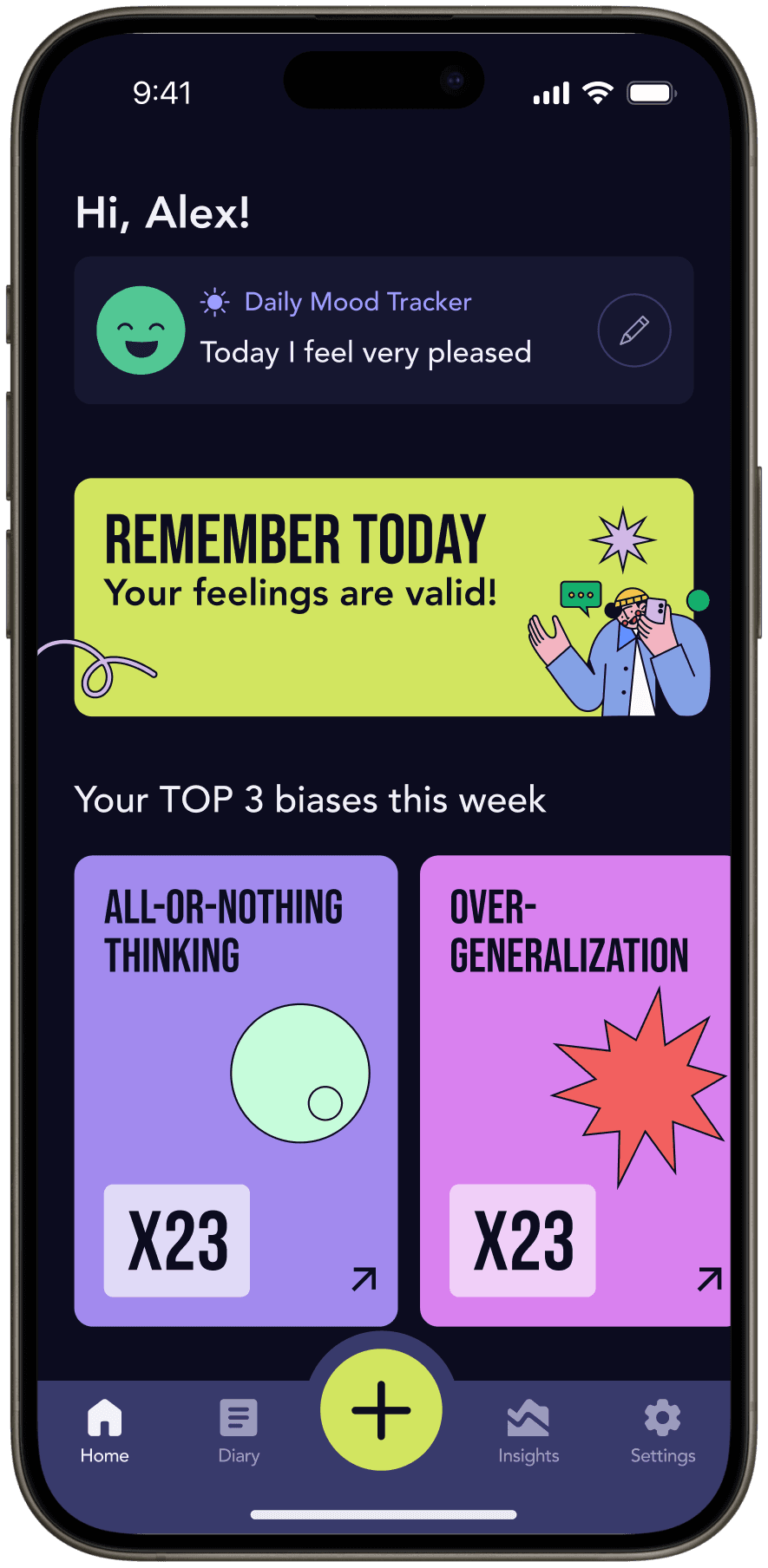
    • Voice-to-text journaling, eliminating typing friction and allowing users to capture thoughts naturally by speaking
    • AI pattern recognition processing entries to identify potential cognitive biases and offer explanations, helping users develop awareness of their thinking patterns
    • Exportable reports summarizing patterns over time, designed for users to share with therapists if desired
    • Subscription processing supporting platform sustainability

    Through focused scope definition we delivered the MVP in 4 months.

  • Stage 2

    AI Calibration and User Experience Improvements

    Following the MVP launch, user feedback revealed critical areas requiring technical refinement. The most significant challenges centered around AI accuracy and user trust, as HEIWA's AI needed to process fragmented thoughts, emotional complexity, and real-life language patterns while maintaining therapeutic value.

    Testing in the Ukrainian market revealed that users frequently code-switched between Ukrainian and English mid-sentence during emotional moments. The basic voice-to-text in the MVP couldn't handle this, causing transcription failures. We developed a custom voice-to-text pipeline with language detection preprocessing, enabling accurate processing of mixed-language inputs that reflect natural emotional expression.

    Given the sensitive nature of this voice data, we implemented privacy-first data architecture ensuring voice recordings were never stored, with audio processing occurring in memory only and immediate data purging after transcription. Analysis processing was implemented on-device where possible, with text storage utilizing encryption and controlled access protocols.

    Early MVP versions allowed freeform journaling with AI analysis of cognitive patterns, but user feedback revealed a critical gap: focusing solely on thoughts without emotional context produced shallow insights. Users were capturing what they were thinking but not how they were feeling or what triggered those thoughts.

    We introduced a Mood-Emotion-Situation entry flow that guided users to identify their emotional state and situational context alongside their thoughts. This approach served two purposes: it created richer data for AI pattern recognition, and it helped users develop more specific emotional vocabulary beyond vague states like "good" or "bad."

    The mood check-in after each entry also enabled temporal pattern analysis—users could see emotional trends over time, such as recurring anxiety before work meetings or improved mood after physical activity. This layer of emotional data significantly improved the relevance and accuracy of cognitive distortion detection.

    The initial AI model demonstrated excessive sensitivity, flagging cognitive distortions in nearly every journal entry and creating a judgmental rather than supportive experience. Our team implemented revised prompting logic with context-aware analysis, moving beyond pattern matching toward adaptive responses based on user context and emotional state.

    Based on feedback from therapists exploring the platform, we redesigned the export system to include emotional spike analysis, recurring pattern identification, and highlighted discussion points. This required developing data processing logic that could identify themes across multiple entries while maintaining individual privacy.

Building a CBT-Based AI Mental Health App from Concept to User Adoption-12
Building a CBT-Based AI Mental Health App from Concept to User Adoption-13

Outcomes and Early Adoption

  • Based on initial tests, HEIWA achieved 2.46K downloads across US and Ukrainian markets and a 4.7-star rating in the US App Store, with user feedback indicating that the platform successfully reduced common barriers to CBT journaling.
  • The key was removing friction through thoughtful technical design. Voice-to-text made reflection feel "less like work and more like a conversation," making journaling accessible even during low-energy moments. The structured entry flow helped users identify patterns they'd previously missed. Active users developed consistent journaling habits, with the platform's design supporting regular reflection without creating pressure or guilt around daily streaks.
  • The therapists who had consulted on the project began testing HEIWA with their own clients, showing interest in its potential as a between-session support tool. The detailed reports allowed therapists to review emotional patterns and cognitive themes before sessions, reducing the time typically spent on recap and allowing them to focus on therapeutic progress. One therapist shared: "It helped one client realize she always felt shame after conversations with her mother, something we'd never pinpointed before." These insights revealed emotional spikes and recurring distortions that manual notes often missed, creating opportunities for more targeted therapeutic approaches.
  • Several therapists began recommending HEIWA to clients, and their feedback identified opportunities for future development, including practice integration features, referral workflows, and enhanced reporting tools designed specifically for therapeutic settings.
  • These early results validated our core hypotheses: that removing friction from CBT journaling could support sustained practice, and that organized emotional data could be valuable both for personal insight and therapeutic work. The dual interest from individual users and mental health professionals confirmed HEIWA's positioning as a tool that works independently while complementing professional therapy. The platform continues to evolve based on user feedback, with ongoing refinements to AI accuracy, pattern recognition, and therapist-focused features.

About Binary Studio

  • Binary Studio is a boutique software development company, regularly praised for its unique blend of engineering excellence and product ownership that enables its clients to build robust and scalable software products.
  • With our development team made up of top 0.5% international tech talent, we build web and mobile platforms using Node.js, .NET, React Native, Flutter, and integrating AI and ML. We also offer full-cycle QA and project management services to ensure the efficient delivery.
  • Our clients see us as a trusted partner dedicated to turning visions into great products. This is proven by 200+ delivered projects, more than two decades of business excellence, and stellar customer reviews.

Schedule a tech consultation

Client ManagerClient Manager

Christina Berko ⠀ 

Client Manager

Maria Kudriavtseva ⠀ 

Pre-Sales Project Manager

Thank you

We’ll reach out within one business day. If you don’t hear from us, check spam and promotions folders.

Send us a message

Attach related materials (.pdf, .docx, .odt, .rtf, .txt, .pptx; max 5 MB)

Related Case Studies